
Did voters just stop the AI buildout? The data center ballot measures, read closely
No. Data center ballot measures passed almost everywhere they appeared on Tuesday, but voters were rejecting power bills, water use and being asked after the fact, not artificial intelligence itself. The compute still gets built, somewhere easier to permit.

In Urbana and Hubbard, Ohio, roughly three-quarters of the people who turned out voted to ban data centers outright. Trenton passed its ban 80-20. Perry voted 87 percent to force any hyperscaler chasing a tax break to post financial guarantees first.
Tuesday was the first American election in which artificial intelligence had a physical address on the ballot. It lost nearly everywhere it was asked. Most of today's coverage has the result right and the reason wrong, so here are the questions the day skipped, with our answers.
What did the data center ballot measures actually reject?
Across 10 states, 45 local measures put data centers in front of voters; by Wednesday morning 33 had passed and six more were projected to follow. The industry's single win came in Harwood, North Dakota. Ohio alone carried 20 measures, and the restriction won or led in every one of them.
| Place | On the ballot | Result |
|---|---|---|
| Urbana and Hubbard, Ohio | Outright ban on data centers | Passed, 76-77% in favor |
| Trenton, Ohio | Ban on data centers | Passed, 80-20 |
| Perry, Ohio | Financial guarantees for hyperscalers seeking tax breaks | 87% in favor |
| Edgewater, Florida | Data center ban written into the city charter | Passed overwhelmingly |
| Harwood, North Dakota | Extra review for industrial projects | Rejected, the industry's only win of the night |
Tallies differ by counter: Engadget logged 45 measures in 10 states, CNBC counted 41, and Semafor reported voters siding against data centers in 37 of 38 races with votes in. Ohio margins via Fortune.
The arithmetic behind the anger is not mysterious. Capacity prices in the PJM grid, which serves 13 states, ran from $28.92 to $329.17 per megawatt-day, and data centers accounted for 63% of one auction's increase, about $9.3 billion recovered from customers. That is roughly $16 a month on an Ohio bill. Abdul El-Sayed put it plainly at a July campaign stop, "People really effing hate data centers," and on Tuesday he won Michigan's Senate seat 52% to 45%.
Our read: this was a siting fight, not a referendum on machine intelligence. Nobody in Perry, Ohio voted against a language model. They voted against a windowless building that arrives with a tax abatement, a substation and a bill they did not sign. Every one of those grievances has a price, and prices can be paid. Expect the industry to start paying them rather than arguing about them.
Microsoft rose 6% on the day data center stocks cratered
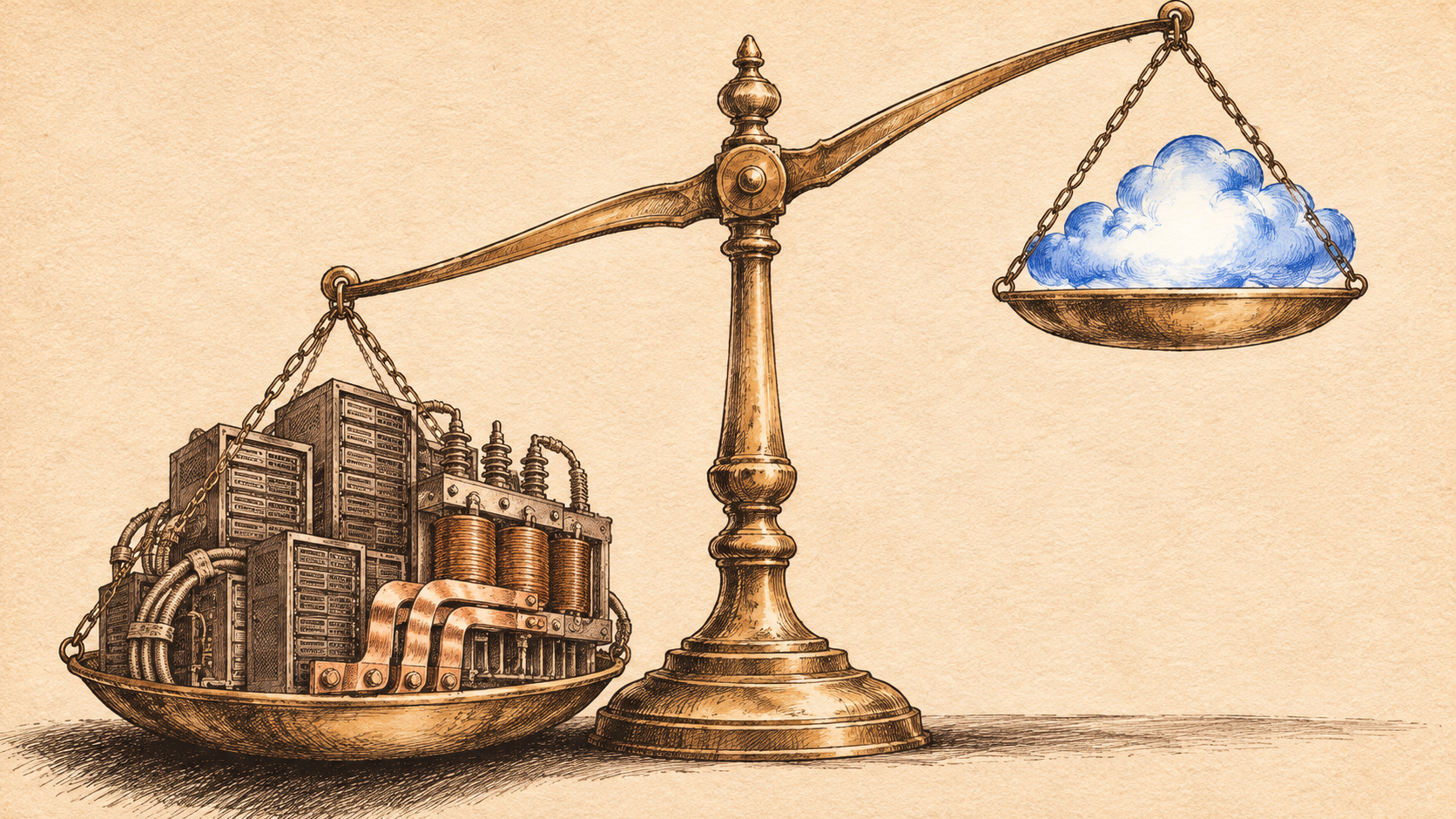
Investors did not sell artificial intelligence on Wednesday. They sold the real estate. Reuters reported data center operators sliding hard while Amazon and Microsoft each jumped about 6% and clean-energy shares rallied, as the market repositioned for a Democratic Congress and tougher scrutiny of the buildout.
| Company | Move on Nov. 4 | What it actually does |
|---|---|---|
| Cipher Digital | down 21% | Builds and leases AI compute sites |
| Vistra | down 15.4% | Power generation for heavy loads |
| GE Vernova | down 11.5% | Turbines and grid equipment |
| CoreWeave | down 9.5% | Rents GPUs by the hour |
| Constellation Energy | down 9.2% | Nuclear power contracted to data centers |
| Applied Digital | down 8.8% | Data center developer |
| Microsoft | up 6% | Owns the capacity it already built |
| Amazon | up 6% | Owns the capacity it already built |
| Alphabet | up 4.6% | Owns the capacity it already built |
Moves during Wednesday's session as reported by Reuters.
Two analysts said the quiet part. Mark Malek of Siebert Financial: "The AI buildout will become more expensive, not disappear." Art Hogan of B. Riley Wealth said the hyperscalers gained because "those assets are more valuable now because there's not going to be an overbuild of data centers." Semafor reported separately that lenders have begun treating local opposition as a credit risk.
The question nobody asked: who wins when it gets harder to build? Not the challengers. A ballot box in Ohio just made every megawatt already energized scarcer and more valuable, which is why the three companies with the most finished capacity had their best day in months. Local democracy, applied to a capital-intensive industry, works as a moat. The backlash against Big Tech's buildout may end up concentrating it.
Did half a billion dollars of AI political money buy anything?
Time reported that Musk spent $446 million across the cycle and that his largest single bet, Ken Paxton in Texas, was beaten by James Talarico, while the accelerationist super PAC Leading the Future deployed more than $100 million to little effect. On the other side, AI-safety groups funneled over $40 million through Public First Action, and Democrats spent north of $100 million on broadcast ads tying Republicans to data centers, winning in Ohio, Kansas and Iowa.
Mayors who backed data centers were recalled in Piqua, Ohio and Yukon, Oklahoma. In Wisconsin, Derrick Van Orden lost his seat after spreading AI deepfakes. "Voters had their say tonight: they are overwhelmingly in support of AI safety and security," said Brendan Steinhauser of the Alliance for Secure AI. The same tools that make a persuasive fake clip of an opponent are now ordinary free text-to-video generators anyone can open in a browser tab.
Our read: the money did not fail because voters are incorruptible. It failed because it argued about ideology while the other side argued about a utility bill. Ad dollars can move an undecided voter on an abstraction. They cannot talk someone out of a number printed on a statement that arrives every month.
Can a school say no to Google's AI and keep Google Search?

Google's education VP Chris Phillips said Search and AI are "deeply integrated" and that students whose schools do not opt in "will not have access to search." TechCrunch reported the backlash: Bernie Sanders called it extortion, Richard Blumenthal said Google was "forcing Gemini into schools," and former FTC chair Lina Khan said the company "remains unchastened" after multiple antitrust losses. Google responded that all three services are off by default and can be enabled individually.
Here is the asymmetry nobody put side by side. Ohio got to vote on whether a building could draw 25 megawatts. No district, parent or student voted on whether a research tool used by tens of millions of American children would come bundled with a chatbot. And this week Netflix began rolling out an AI Discover tab on US televisions that picks what you watch by mood, which arrived with no hearing, no measure and no objection.
Our read: Americans are not anti-AI, they are anti-surprise, and they object most where the cost is visible. The same household that voted to ban a data center will let an algorithm choose tonight's movie, ask a chatbot how to fix the dishwasher and hand a teenager an AI homework helper at the kitchen table. Acceptance tracks the bill, not the technology. Which means the policy fight of 2027 is about ratepayers, and the cultural fight is about children.
The same week, Beijing started drafting one law for all of it
While 18 Ohio municipalities wrote AI policy one charter amendment at a time, Caixin reported that Wang Ruomeng, a deputy director at China's National Development and Reform Commission, said on November 3 that the country will accelerate comprehensive AI legislation covering data, computing power and algorithms, plus rules for key application scenarios. China has no unified national AI law yet; this is the opening move toward one.
Set the two systems next to each other. One writes AI rules once, centrally, to make building faster. The other now writes them in 45 separate municipal elections, a Democratic Congress, dozens of state legislatures and the public utility commissions nobody can name. Both are real forms of governance. They optimize for opposite things.
What may change: the push to preempt state AI laws with a single federal statute just got much harder, because the chamber that would pass it changed hands and because the voters who would be preempted were the ones casting the ballots. Expect the next twelve months of American AI law to be made by regulators and zoning boards, not by Congress. That is slower, more local, and far less legible to anyone writing a capital plan.
The bet: the fight moves somewhere almost nobody votes
Elon Musk's reaction to the results was one line: "Data centers in space looking pretty appealing right now." It is a joke that tells you the instinct, which is to route around the voter rather than negotiate with him. Earth-bound options are cheaper: behind-the-meter gas and nuclear, sites in states without local referenda, and tariffs that put the cost of new capacity on the company instead of the household.
Tuesday was an affordability verdict, and AI was only half of it. The other half showed up in the oil pits, where WTI fell about 9% to $87.59 after the sweep, and in Vice President Vance's post on Wednesday: "The reason we lost is the war." A war and a power bill, judged by the same electorate on the same day, for the same reason.
Our bet for the next year: not a single gigawatt gets cancelled because of Tuesday, but the average project adds six to twelve months and a ratepayer-protection clause. The real action shifts from ballot measures to state utility commissions, where hearings are long, turnout is zero and the people who show up are lawyers. A movement that just won 37 of 38 votes is about to discover its next opponent does not hold elections.
And the quieter half keeps compounding. Nothing voters did on Tuesday slows down the AI sitting in a phone, a TV or a browser, where a person can make an image in thirty seconds and never see a kilowatt-hour attached to it. That gap between the AI people banned and the AI they used the same evening is the whole story of this election.
Questions and answers
How many data center ballot measures passed in the 2026 midterms?
Engadget counted 45 data center measures across 10 states, with 33 passed and six more projected by Wednesday morning. Semafor reported voters siding against data centers in 37 of the 38 races with votes counted, the lone exception being Harwood, North Dakota.
Do data centers raise my electricity bill?
In the PJM region they already have: Fortune reported capacity prices rising from $28.92 to $329.17 per megawatt-day, with data centers driving 63% of one auction's increase, about $9.3 billion recovered from customers. That works out to roughly $16 a month on an Ohio household bill.
Which AI stocks fell after the Democratic midterm sweep?
Reuters reported Cipher Digital down 21%, Vistra down 15.4%, GE Vernova down 11.5%, CoreWeave down 9.5% and Applied Digital down 8.8% on November 4. Microsoft and Amazon rose about 6% each and Alphabet gained 4.6%, because existing capacity became scarcer.
Is Google turning off Search for schools that ban AI?
Google's education VP told TechCrunch that Search and AI are deeply integrated and students at schools that do not opt in will not have access to Search. After criticism from Bernie Sanders, Richard Blumenthal, Lina Khan and Mayor Mamdani, Google said Search, Gemini and Gemini Notebook are off by default and can each be enabled individually.
Arthur Down is a journalist with more than 12 years of experience writing about technology, personal finance, health and everyday consumer topics. He studied Journalism and Media Studies at the University of Sheffield, started as a reporter at a regional newspaper and has worked freelance since 2014. At N33 he writes and edits the blog's practical guides to AI tools.
How we research, source and review articles