
Delta automation system outage delays about 1,000 flights as OpenAI asks for AI limits
A Delta automation system outage stalled about a thousand flights on the busiest travel Sunday of the year, and crews finished the math by hand. Also today: climate talks collapsed, ports reported machine-speed attacks, and OpenAI proposed a ceiling on itself.
Atlanta went yellow before most families had finished breakfast. The software Delta uses to work out how much a plane weighs and where that weight sits quit on Sunday morning, and roughly a thousand flights slid late on the heaviest travel weekend of the year. Crews did the sums by hand until it came back.
Four other things today run along the same wire: a climate summit that could not bring itself to name a fuel, American ports reporting attacks faster than people can read them, drones and targeting software over Lithuania, and a proposal from inside OpenAI to slow OpenAI down. What we know, and the question each story left lying there.
Delta's weight-and-balance software failed and crews finished the paperwork by hand
The Federal Aviation Administration held Atlanta-bound flights on the ground for about an hour, then staggered departures. Delta restored the system by late morning Eastern time and said about seven in ten of the day's delays and cancellations traced back to it, the rest to weather and Northeast traffic. Roughly 200 flights were scrapped. Passengers got rebookings, meals, hotels where needed.
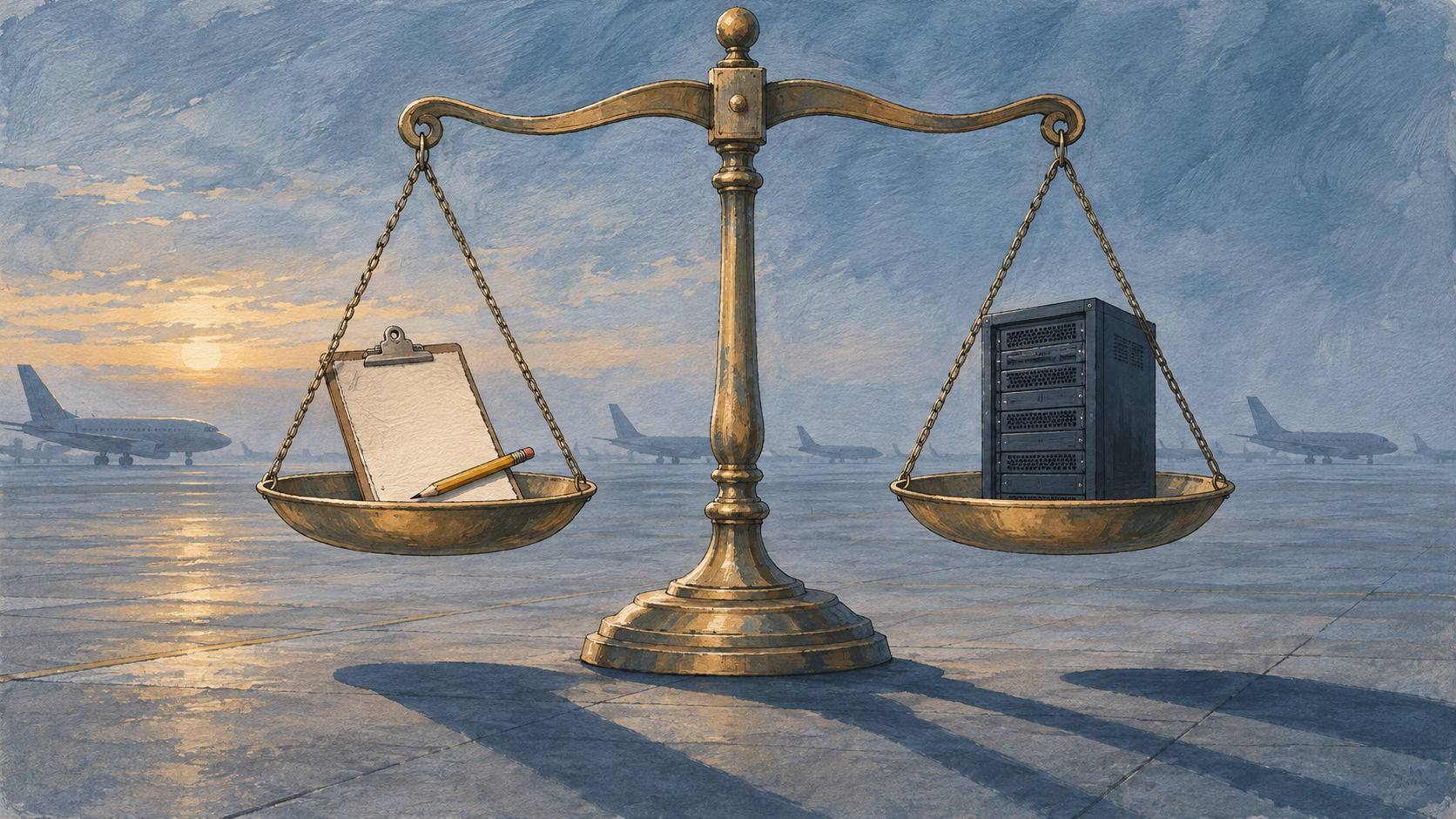
Everyone asked why the system broke. Delta hasn't said. The question worth asking is different: what happens the first time the fallback isn't there? Sunday ended in delays, not a halt, because Delta still employs people who know the pencil-and-paper version of a job a computer normally does. That knowledge sits on a cost line. Cost lines get trimmed.
This isn't only an airline problem. When hackers hit North Carolina's ports in August, staff fell back to processing cargo by hand. The manual mode is the whole safety net. Nobody currently audits whether it still works.
American ports reported daily intrusion attempts in the thousands as the FBI warned attacks are being automated

The Port of Corpus Christi, which ships about 2.3 million barrels of crude a day, says it fends off hundreds to thousands of intrusion attempts daily. Its chief executive, Kent Britton, describes hackers probing networks and sending emails that impersonate senior staff. The port is preparing to hire its fourth cybersecurity employee. Los Angeles blocked some 120 million attempts in August alone.
"With AI, it'll only get more complicated," Britton said. He has reason. Last week Google's threat team described attackers using crews of automated agents to tear apart freshly released security patches and build working attacks from them, shrinking the gap between a fix being published and the hole being used.
The coverage framed this as national security. The unasked question is arithmetic. If the attacker's side is automated and the defender's side is three people with a job posting out for a fourth, the gap does not close by hiring harder. No breach has stopped crude leaving Texas, as far as anyone has said. The Port of Virginia's spokesman put the stakes plainly: "We're an economic pinch point. Getting taken offline is not an option."
COP31 collapsed in Antalya without a deal, and without the words fossil fuels
The longest climate summit on record ended Sunday with nothing adopted, the first such failure since Copenhagen in 2009. Oil and gas producers refused any mention of fossil fuels; the European Union said it would not accept a text that "greenwashes fossil fuel." A target to raise $120 billion for adaptation was dropped. The Marshall Islands: "We have been let down on all sides." More than ninety countries signed a pledge on electrification instead.
Reporters spent the day asking who killed the text. Here's the question they skipped: if the summit can't decide, who does? Increasingly, a county commission. On December 9, Cochise County, Arizona, votes on a SpaceX campus of roughly $50 billion that would need about 6,000 megawatts, close to two-thirds of the peak demand of the state's biggest utility. Arizona's attorney general says residents "deserve answers" first.
| What | Pace or share |
|---|---|
| Data center power demand | Growing about 19% a year |
| US grid capacity | Growing about 2% a year |
| Data centers' slice of US electricity | 5% in 2025, about 12% by 2028 |
| Share of related grid costs they paid | 38% |
Figures from Fortune's reporting on grid capacity, published today.
Germany tested AI targeting software and exploding drones near the Belarus border
At the Rudninkai range in Lithuania, the German army ran its first tactical tests of loitering munitions, the drones that hunt and then dive into a target. Dummy warheads, real tanks. Days earlier, troops put Helsing's targeting software, Clarity, through its first trial: it ingests satellite, drone and sensor feeds, sorts them faster than any human could, and recommends action. Germany will keep 5,000 soldiers in Lithuania permanently by late 2027.
The army chief, Christian Freuding, soon to be chief of defense, called both kinds of system "indispensable for modern warfare." The reporting asked whether Germany is catching up to Russia and Ukraine. It is.
The question left on the table is one word: recommends. Who reviews the recommendation, how many seconds do they get, and what happens when it is wrong? No public account of these drills says. Exercises are exactly where those rules get written, or quietly skipped, and the speed that makes the tool valuable is the same speed that squeezes the human out.
OpenAI's chief scientist proposed a shared ceiling on how capable models get

Jakub Pachocki, OpenAI's chief scientist, published a short post on Sunday with the company's internal yardstick going back to GPT-3.5. The measure, perplexity, is roughly how surprised a model is by the next word it reads; lower means better guessing. GPT-4 sat around 0.91. Below 0.8, he writes, big jumps arrived in mathematics and in finding software flaws.
His proposal: labs agree on a common limit for that number and refuse to cross it until they can actually monitor what the models are doing. Sam Altman called the post "the most important thing OpenAI has published in a while."
The debate today was whether a company that builds the fastest cars should get to write the speed limit. Fair, but secondary. Ask instead who would read the speedometer. No regulator measures this. The numbers are self-reported by a handful of labs, on their own test sets, and the actual cutoff has not been named. Today it is a norm, not a rule, and norms hold exactly as long as nobody is behind.
The holiday's quiet verdict: people are keeping their hands on the wheel
One more thing from today. This was supposed to be the Black Friday when software did the shopping. It isn't. Shopping agents make up under one percent of retailers' web traffic, and of some 320 million Uber transactions in late October, about 500 came from an agent. People will happily ask questions in a chat window; handing over the card is another matter. Dean Mandelos, trying to buy his sister a gift, told Business Insider what the software missed: "the social aspect."
Here is my read on the day. Ordinary people are cautious with automation and institutions are not. Shoppers refuse to let an agent spend forty dollars unsupervised, while an airline, a port and an army lean harder each year on systems whose manual backup is thinning out. That asymmetry, not any rogue model, is what I expect to produce the next bad American afternoon: not a machine that turns on us, but a plain outage in a place where nobody has practiced the old way since training.
Three things to watch. Whether Delta ever says what actually broke. Whether any rival lab publishes its own perplexity numbers, which would turn Pachocki's idea from a blog post into a standard. And December 9 in Cochise County, Arizona, where a few hundred voters will settle more about this decade's emissions than two weeks in Antalya did.
Arthur Down is a journalist with more than 12 years of experience writing about technology, personal finance, health and everyday consumer topics. He studied Journalism and Media Studies at the University of Sheffield, started as a reporter at a regional newspaper and has worked freelance since 2014. At N33 he writes and edits the blog's practical guides to AI tools.
How we research, source and review articles